Page 377 - Learnwell EVS
P. 377
Interagency Emergency Health Kit
Rule 4:
Take the child to a health worker if there are signs of dehydration or
other problems
The mother should take her child to a health worker if the child:
Starts to pass many watery stools
Vomits repeatedly
Becomes very thirsty
Is eating or drinking very poorly
Develops a fever
Has blood in the stool; or
Does not get better in three days‐
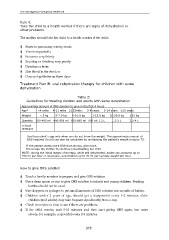
Treatment Plan B: oral rehydration therapy for children with some
dehydration
Table 2:
Guidelines for treating children and adults with some dehydration
Approximate amount of ORS solution to give in the first 4 hours
Age* <4 mths 4-11 mths 12-23mths 2-4 years 5-14 years ≥15 years
Weight < 5 kg 5-7.9 kg 8-10.9 kg 11-15.9 kg 16-29.9 kg ≥30 kg
Quantity 200-400 ml 400-600 ml 600-800 ml 800 ml-1.2 L 1.2-2 L 2.2-4 L
In local
measure
Use the patient's age only when you do not know the weight. The approximate amount of
ORS required (in ml) can also be calculated by multiplying the patient’s weight in kg by 75.
If the patient wants more ORS than shown, give more.
Encourage the mother to continue breastfeeding her child.
NOTE: during the initial stages of therapy, while still dehydrated, adults can consume up to
750 ml per hour, if necessary, and children up to 20 ml per kg body weight per hour.
How to give ORS solution
Teach a family member to prepare and give ORS solution.
Use a clean spoon or cup to give ORS solution to infants and young children. Feeding
bottles should not be used.
Use droppers or syringes to put small amounts of ORS solution into mouths of babies.
Children under 2 years of age, should get a teaspoonful every 1‐2 minutes; older
children (and adults) may take frequent sips directly from a cup.
Check from time to time to see if there are problems.
If the child vomits, wait 5‐10 minutes and then start giving ORS again, but more
slowly, for example, a spoonful every 2‐3 minutes.
318
Rule 4:
Take the child to a health worker if there are signs of dehydration or
other problems
The mother should take her child to a health worker if the child:
Starts to pass many watery stools
Vomits repeatedly
Becomes very thirsty
Is eating or drinking very poorly
Develops a fever
Has blood in the stool; or
Does not get better in three days‐
Treatment Plan B: oral rehydration therapy for children with some
dehydration
Table 2:
Guidelines for treating children and adults with some dehydration
Approximate amount of ORS solution to give in the first 4 hours
Age* <4 mths 4-11 mths 12-23mths 2-4 years 5-14 years ≥15 years
Weight < 5 kg 5-7.9 kg 8-10.9 kg 11-15.9 kg 16-29.9 kg ≥30 kg
Quantity 200-400 ml 400-600 ml 600-800 ml 800 ml-1.2 L 1.2-2 L 2.2-4 L
In local
measure
Use the patient's age only when you do not know the weight. The approximate amount of
ORS required (in ml) can also be calculated by multiplying the patient’s weight in kg by 75.
If the patient wants more ORS than shown, give more.
Encourage the mother to continue breastfeeding her child.
NOTE: during the initial stages of therapy, while still dehydrated, adults can consume up to
750 ml per hour, if necessary, and children up to 20 ml per kg body weight per hour.
How to give ORS solution
Teach a family member to prepare and give ORS solution.
Use a clean spoon or cup to give ORS solution to infants and young children. Feeding
bottles should not be used.
Use droppers or syringes to put small amounts of ORS solution into mouths of babies.
Children under 2 years of age, should get a teaspoonful every 1‐2 minutes; older
children (and adults) may take frequent sips directly from a cup.
Check from time to time to see if there are problems.
If the child vomits, wait 5‐10 minutes and then start giving ORS again, but more
slowly, for example, a spoonful every 2‐3 minutes.
318