Page 374 - Learnwell EVS
P. 374
Assessment and treatment of diarrhoea
Annex 2:
Assessment and treatment of diarrhoea 53
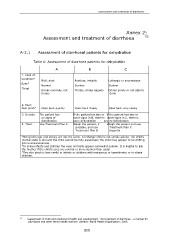
A-2.1 Assessment of diarrhoeal patients for dehydration
Table 1: Assessment of diarrhoea patients for dehydration
A BC
1. Look at: Well, alert Restless, irritable Lethargic or unconscious
Condition a Normal Sunken
Eyes b Drinks normally, not Thirsty, drinks eagerly Sunken
thirsty
Thirst Drinks poorly or not able to
drink
2. Feel: Goes back quickly Goes back slowly Goes back very slowly
Skin pinchc
3. Decide: The patient has If the patient has two or If the patient has two or
4. Treat: no signs of
dehydration more signs in B, there is more signs in C, there is
Use Treatment Plan A some dehydration severe dehydration
Weigh the patient, if Weigh the patient and use
possible, and use Treatment Plan C
Treatment Plan B Urgently
a Being lethargic and sleepy are not the same. A lethargic child is not simply asleep: the child's
mental state is dull and the child cannot be fully awakened; the child may appear to be drifting
into unconsciousness.
b In some infants and children the eyes normally appear somewhat sunken. It is helpful to ask
the mother if the child’s eyes are normal or more sunken than usual.
c The skin pinch is less useful in infants or children with marasmus or kwashiorkor or in obese
children.
53 Department of Child and Adolescent Health and Development. The treatment of diarrhoea - a manual for
physicians and other senior health workers. Geneva: World Health Organization; 2005.
315
Annex 2:
Assessment and treatment of diarrhoea 53
A-2.1 Assessment of diarrhoeal patients for dehydration
Table 1: Assessment of diarrhoea patients for dehydration
A BC
1. Look at: Well, alert Restless, irritable Lethargic or unconscious
Condition a Normal Sunken
Eyes b Drinks normally, not Thirsty, drinks eagerly Sunken
thirsty
Thirst Drinks poorly or not able to
drink
2. Feel: Goes back quickly Goes back slowly Goes back very slowly
Skin pinchc
3. Decide: The patient has If the patient has two or If the patient has two or
4. Treat: no signs of
dehydration more signs in B, there is more signs in C, there is
Use Treatment Plan A some dehydration severe dehydration
Weigh the patient, if Weigh the patient and use
possible, and use Treatment Plan C
Treatment Plan B Urgently
a Being lethargic and sleepy are not the same. A lethargic child is not simply asleep: the child's
mental state is dull and the child cannot be fully awakened; the child may appear to be drifting
into unconsciousness.
b In some infants and children the eyes normally appear somewhat sunken. It is helpful to ask
the mother if the child’s eyes are normal or more sunken than usual.
c The skin pinch is less useful in infants or children with marasmus or kwashiorkor or in obese
children.
53 Department of Child and Adolescent Health and Development. The treatment of diarrhoea - a manual for
physicians and other senior health workers. Geneva: World Health Organization; 2005.
315